
Cerritos · Los Angeles County · Gateway Cities
Cerritos flex and industrial space for lease
Every tenant here clears the same gate. We have watched 200 businesses walk up to it.
Over the 24 months to August 19, 2026, 200 businesses asked KEYZ Commercial about space at one Cerritos flex property. Not one of them could have opened by right – because Cerritos Municipal Code §22.28.300 permits no use by right in the M zone at all. That is not a reason to look elsewhere. It is the reason the corridor stays what it is, and the reason the path is worth knowing before you sign.
- 200
- Leasing inquiries counted
24 months, one property
- 0
- Uses permitted by right
in the Cerritos M zone
- 2
- Public hearings to approve
a conditional use
- 261
- Industrial parcels citywide
LA County roll, 2025
What this page is, and what it is not
Read this part before you trust the rest
This is a regulatory and demand brief for small-bay flex and industrial space in Cerritos, California. It is built from four sources and no others: KEYZ Commercial’s own leasing management system, the Cerritos Municipal Code, the Los Angeles County assessment roll, and the City of Cerritos’ own published material. There is no subscription market data anywhere in it – no CoStar, no LoopNet, no Crexi. Where those sources could not answer a question, this page says so rather than filling the hole with an estimate.
It is not a market report. The demand data describes one property – a single eight-suite flex project on State Road – and one brokerage’s inbound pipeline. It is a good look at what kind of business wants a 1,600-to-4,100 square foot bay in this city, and a poor proxy for absorption, vacancy or pricing across the submarket. Anyone who tells you 200 inquiries at one address measures a market is selling you something.
Why there are no rents on this page
We represent the owner of the property discussed here. Our client’s rent is our client’s confidential business information, and a corridor rate table is assembled out of other landlords’ deal terms. Publishing either would tell you precisely what we would do with yours. What we will do instead, on this page, is explain how occupancy cost is built – lease basis, base year, pro rata share, escalation – and then quote you on the actual space when you call. That is a deliberate trade of traffic for trust.
Cerritos: where it sits and how it pays for itself
Location, connectivity, trade area, and the revenue mix that shapes City policy
The City puts its own location this way, on its business development pages: “Located in the geographical center of the Los Angeles/Orange County metropolitan area, Cerritos is directly served by the 5, 605 and 91 Freeways.” And, at more length: “Cerritos is located in the heart of the Los Angeles/Orange County metrocenter, midway between Downtown Los Angeles and the business centers of Irvine, Santa Ana and Anaheim. Because Cerritos is virtually the geographic center of the Los Angeles Basin, it has become one of Southern California’s premier commercial crossroads. Cerritos is served directly by three major freeways and is close to two others.”
Worth noting what the City does not claim. Across every business-facing page we could find on cerritos.gov, there is no mention of the Port of Long Beach, the Port of Los Angeles, the Alameda Corridor, or rail. The City’s own connectivity story is freeways, transit and three airports. If a listing tells you this is a port-logistics location, that claim is not coming from the City.
Cerritos by the numbers
Sheet 01 / Census
| Measure | Value | Vintage, exactly as the source labels it |
|---|---|---|
| Population estimate | 46,367 | Population estimates, July 1, 2025, (V2025) |
| Population, decennial census | 49,578 | Population, Census, April 1, 2020 |
| Change, 2020 base to 2025 estimate | −6.5% | (V2025) |
| Land area | 8.73 sq mi | Land area in square miles, 2020 |
| Population per square mile | 5,681.0 | Population per square mile, 2020 |
| Households | 16,065 | Households, 2020–2024 |
| Median household income | $135,439 | in 2024 dollars, 2020–2024 |
| Total employer establishments | not published | 2023 – suppressed at this geography |
How the City is funded, and why that matters to an industrial tenant
Cerritos runs on sales tax. The City states it plainly: “Sales tax revenues make up nearly half of the overall General Fund,” and separately, “Cerritos is considered a ‘no-low property tax’ city, meaning the City receives a smaller share of property tax revenue than surrounding cities. As a result, the City relies on other revenue sources, such as sales tax and fees, to support essential services.” For fiscal year 2025–26 the City budgeted $43.8 million of sales tax against $101,503,081 of General Fund revenue – 43.2%, a percentage we computed, because the City publishes the dollars and not the share.
That structure is under strain, in the City’s own words: “General Fund expenditures are projected to outpace General Fund revenues over time, resulting in recurring structural deficits,” and “General Fund reserves are declining steadily and are projected to fall below the City’s minimum reserve policy threshold within the forecast period.” The adopted 2026–27 budget “requires $10.6 million in General Fund reserves to cover the gap.” In June 2026 the Council declined to put a 1% transactions and use tax to voters and cut services instead.
The read-through
A city that funds itself on sales tax has a structural preference for uses that generate sales tax. Industrial space does not. That does not make Cerritos hostile to industrial tenants – it does mean the entitlement process is the place where the City exercises discretion, and it points toward fee pressure rather than fee relief. Read the approval path below with that in mind.
One further structural fact that a commercial tenant should know: the City is itself a major commercial and industrial ground lessor. It states that it owns “the revenue generating land of the Cerritos Towne Center, the Lincoln Station Shopping Center, as well as commercial properties in the Cerritos Auto Square and industrial properties within the Cerritos Industrial Park,” and that these “are a significant source of revenue to the City through the ground lease revenue that they collectively generate.” Some Cerritos industrial land is offered on long-term City ground lease rather than in fee. Verify parcel by parcel before assuming otherwise.
What the city physically contains
261 industrial parcels, counted from the county roll, with the query attached
The Los Angeles County Assessor publishes the assessment roll as an open dataset, and its terms of use grant “a license to copy, publish, distribute and/or transmit the Data, to adapt the Data and to exploit the Data for commercial and/or personal use.” So the following count is ours to publish. Three filtering decisions do most of the work, and getting any of them wrong changes the number badly.
Industrial parcels, City of Cerritos, roll year 2025
Sheet 02 / County roll
| Use code family | What the Assessor’s own decode field calls it | Parcels |
|---|---|---|
| 33xx | Warehousing, distribution and storage | 163 |
| 31xx | Light manufacturing | 82 |
| 30xx | Industrial, vacant or no second-digit use | 5 |
| 38xx | Industrial, lumber and mill family | 4 |
| 32xx | Heavy manufacturing | 3 |
| 34xx–37xx, 39xx | Residual, derived by subtraction | 4 |
| Total industrial parcels | 261 | |
Of those 261, 255 carry a recorded improvement value and 6 do not. On a second measure, 253 carry a recorded main building area and 8 do not.
The reproducible query, so the next quarterly refresh returns the identical number:
https://services.arcgis.com/RmCCgQtiZLDCtblq/arcgis/rest/services/Parcel_Data_2021_Table/FeatureServer/0/query?returnCountOnly=true&f=json&where=RollYear='2025'+AND+SitusCity+LIKE+'CERRITOS%'+AND+UseCode+LIKE+'3%'
RollYear='2025' multiplies the count by five. 2025 is the most recent roll published; a query for later years returns zero rows. Situs city as a prefix. Matching SitusCity='CERRITOS' exactly returns one parcel, because the roll overwhelmingly stores ‘CERRITOS CA’. The prefix match returns 15,887 – a 99.99% difference. The narrow use code. We used UseCode, the four-character field, not the coarse type field. As a control, the Assessor’s own decode field UseCodeDescChar1='Industrial' returns 261 as well. A third field, UseType, is populated but returns zero for every documented value countywide; we did not use it and neither should you.What we will not tell you from this data
We are not publishing a small-bay statistic off the roll, and here is why. The building-area field records the main square footage of the primary building record on a parcel, and parcels can carry several buildings. A multi-tenant business park recorded as one 60,000 square foot building lands in a large-building bucket even if every suite inside it is 2,500 square feet. That is a parcel and building size distribution, not a bay size distribution, and treating one as the other would be precision at the wrong altitude. The most we will say from the roll is that 100 of the 253 Cerritos industrial parcels with a recorded building carry a primary building under 25,000 square feet.
How much industrial land there is, and the vintage problem with that question
The City’s own land use inventory sits in the Land Use Element of a General Plan last comprehensively updated on January 6, 2004, working from an August 2001 inventory with a 2020 horizon. On that inventory the city totals 5,696.00 acres, of which 697.85 acres and 11,343,771 square feet are designated Light Industrial and a further 28.83 acres Industrial/Commercial. The plan states that “The City of Cerritos is a mature and urbanized city. Most of the land within the City has been developed (over 99 percent),” and that “In August 2001, only a very limited amount of land, approximately 27 acres, in the City was vacant.”
Those are the City’s most recent published acreage figures and they are twenty-five years old. The horizon year of the build-out table has already passed. We are reporting them because they are the only City-published numbers that exist, not because they describe 2026. If you need current industrial acreage in Cerritos, it is not published, and we could not source it.
What 200 businesses asked for
One property, 24 months, including every inquiry that went nowhere
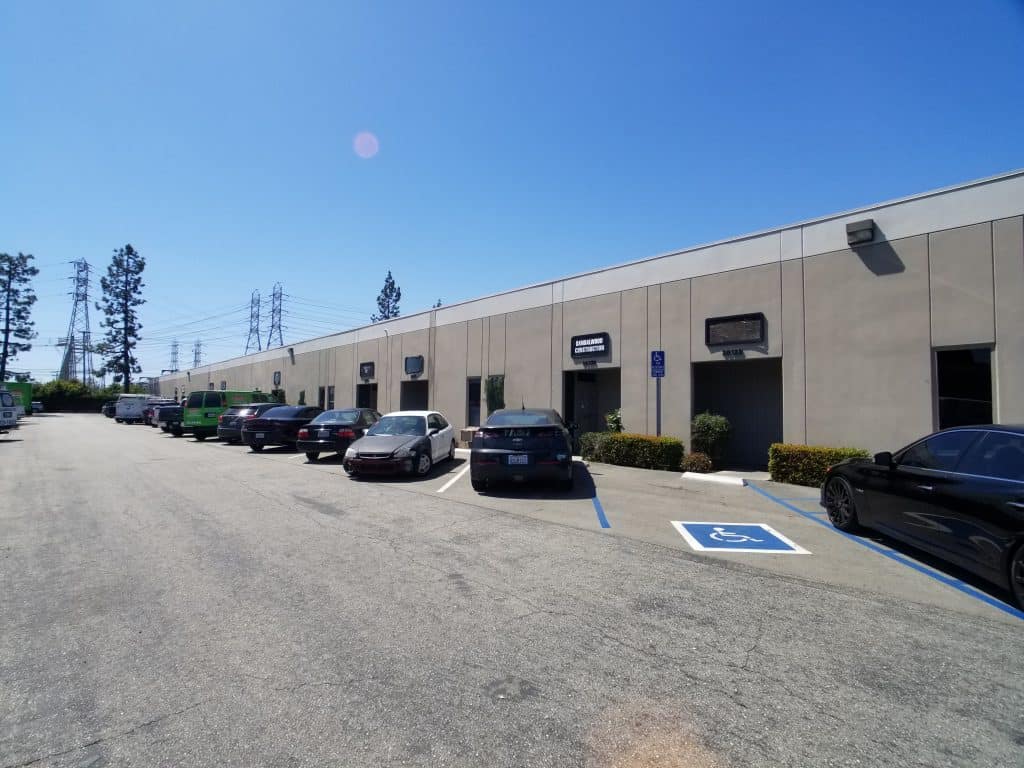
KEYZ Commercial has represented the ownership of an eight-suite flex project on State Road, Cerritos, CA 90703 – suites from 1,620 to 4,130 square feet, five leased and three currently available. Every inbound inquiry lands in KEYZ Commercial’s leasing management system as a dated record. We enumerated the whole list rather than searching it, included closed records, and paged to exhaustion.
The denominator, and how we got to it
Sheet 03 / Pipeline
| Step | Records |
|---|---|
| In the list, created 2024-08-27 through 2026-08-19 | 204 |
| Excluded: records literally titled “Test” | −2 |
| Excluded: existing-tenant matters, not new-tenant inquiries | −2 |
| Counted – the denominator for every table on this page | 200 |
| Intended use, as the record states it | Inquiries | Share of 200 |
|---|---|---|
| Use not stated in the record | 71 | 35.5% |
| Contractor & building trades | 33 | 16.5% |
| Warehouse, storage & distribution | 22 | 11.0% |
| Automotive & vehicle services | 15 | 7.5% |
| Light manufacturing & fabrication | 13 | 6.5% |
| Office & professional services | 11 | 5.5% |
| Recreation, fitness & indoor sports | 9 | 4.5% |
| Studio, creative & events | 7 | 3.5% |
| Institutional & community | 6 | 3.0% |
| Retail & consumer sales | 4 | 2.0% |
| Apparel, printing & textiles | 3 | 1.5% |
| Pet & animal services | 2 | 1.0% |
| E-commerce & online retail | 2 | 1.0% |
| Food & beverage production | 2 | 1.0% |
| Total | 200 | 100.0% |
The largest category is our own failure
Seventy-one of 200 records – 35.5% – name a person or a company but never state what the business intends to do in the space. In a zone where use is the only thing that determines whether a deal is possible, that is a serious intake gap, and it is ours, not the City’s. We are reporting it because burying it would make every other percentage on this page look firmer than it is. Read the twelve identified categories as shares of the 129 records that stated a use if you prefer; we have shown them against the full 200 so that one denominator governs the whole page.
A second, narrower note: the classifier keys on the intended use the record states, not on inference from a company name. Where a record carries a trading name that hints at an activity but states no intended use, it stays in “use not stated” rather than being scored on the hint.
What happened to them
| Status | State | Records | Share of 200 |
|---|---|---|---|
| Leased | Resolved | 7 | 3.5% |
| Landlord declined | Resolved | 28 | 14.0% |
| Dead lead | Resolved | 12 | 6.0% |
| Client not interested | Resolved | 5 | 2.5% |
| No further action | Resolved | 108 | 54.0% |
| Closed | Resolved | 2 | 1.0% |
| Different needs | Live | 20 | 10.0% |
| Waitlist | Live | 8 | 4.0% |
| Contact made | Live | 6 | 3.0% |
| Under consideration | Live | 3 | 1.5% |
| Tour scheduled | Live | 1 | 0.5% |
| Resolved 162 + live 38 | 200 | 100.0% | |
Two honest caveats on that table
“Resolved” and “live” follow the leasing system’s own status typing, not our judgment, so the split is reproducible. That has one odd consequence worth naming: “different needs” – 20 records, a tenant whose requirement the property could not meet – is typed as an open status and therefore counts as live, even though it functions as an outcome. If you prefer to read it as resolved, the split becomes 182 resolved and 18 live. The denominator does not move.
Seven leases from 200 inquiries is a 3.5% conversion. We are publishing that rather than a flattering subset. It is a normal number for unfiltered inbound on small-bay space, and the reason it is normal is the subject of the next two sections.
Which businesses the Cerritos M zone actually allows
Every category above, against the section text, with a verdict
The governing chapter is Cerritos Municipal Code Chapter 22.28, M – Industrial Zone. It opens with §22.28.300, which reads in full:
CMC §22.28.300 Permitted uses
“No use shall be permitted in the M zone except as a conditional or accessory use in accordance with the provisions of this chapter and except as provided for in the emergency shelter (M-1) overlay zone as set forth in Chapter 22.60.”
Read the qualifier carefully, because it is the difference between a true statement and a false one. There is an exception, and it is the M-1 emergency shelter overlay. §22.60.200 locates that overlay as “bounded by the Coyote Creek Channel to the west and north, Valley View Avenue to the east and 183rd Street to the south.” The State Road industrial block sits roughly a mile south of 183rd Street and the City’s own parcel data records its zone as M, not M-1 – so on this property the exception does not reach. Elsewhere in the M zone it may. “Nothing by right” is accurate here; “nothing by right anywhere in Cerritos’ M zone” would not be.
What follows applies each demand category above to §§22.28.300, .350, .400, .430 and .500. Verdicts are carried by an icon and a word, never by color alone.
| Category | Inquiries | What the code says | Verdict |
|---|---|---|---|
| Warehouse, storage & distribution | 22 | Conditional use, expressly listed. §22.28.430(11) “Wholesaling and warehousing.” Self-storage is separately listed at §22.28.430(12), subject to §22.40.730. But §22.28.500(4) prohibits “Truck terminals or car storage,” which is where a trucking or vehicle-storage plan fails. | ✓Listed – CUP |
| Contractor & building trades | 33 | Not listed anywhere in §22.28.430. No “contractor,” “contractor’s office,” “contractor’s yard” or “trade shop” category exists. Office-only may be considered under §22.28.430(1); anything with storage or fabrication needs a §22.20.100 comparable-use determination first. §22.28.400(1): “All operations and storage of equipment and materials shall be within completely enclosed buildings.” | ▲Not listed – determination first |
| Automotive & vehicle services | 15 | Expressly prohibited, in part. §22.28.500(1) “Automobile repair” and (4) “Truck terminals or car storage.” §23.20.110 forecloses the workaround: “a variance shall not be granted to permit a land use not authorized by the applicable land use zone.” Non-repair vehicle services – tinting, wraps, detailing – are not named in either list and would need a §22.20.100 determination. | ✗Prohibited – repair & storage |
| Light manufacturing & fabrication | 13 | Conditional use, expressly listed – but only the enumerated categories. §22.28.430(4) covers machinery, electrical equipment and precision instruments; products made from pre-prepared metal, plastic, wood, cloth, leather and ceramic; chemicals and pharmaceuticals; and food products. Machine shops at (3), metal plating at (5), laboratories at (10). | ✓Listed – CUP |
| Office & professional services | 11 | Conditional use, expressly listed. §22.28.430(1) “Business and research offices.” Parking is the binding constraint, not the use: §22.28.700(9)(a) requires one space per 250 square feet for office, against one per 1,000 for the first 20,000 square feet of warehouse. | ✓Listed – CUP |
| Recreation, fitness & indoor sports | 9 | Not listed. Recreation appears in the M zone only at §22.28.350(1), “Employee recreational facilities and play areas,” which are permitted “only in conjunction with an approved conditional use” – that is, for a tenant’s own staff, not as a membership business. A commercial gym needs a §22.20.100 determination and then a CUP. | ▲Not listed – determination first |
| Studio, creative & events | 7 | Not listed. Photo, video and rehearsal studios have no category in §22.28.430. Event use additionally runs into §22.28.500(7), which prohibits “Public and private auctions and auction-related events and activities.” | ▲Not listed – determination first |
| Retail & consumer sales | 4 | Ancillary only. §22.28.430(14) allows “Limited retail sales and service in conjunction with any other use in this section” – so retail rides along with a listed use, it does not stand alone. §22.28.100 states the zone is for activities “of a nonretail nature.” Separately, §22.40.320 prohibits electronic cigarette retail “in any zoning district located within the city of Cerritos,” and §22.40.300 declares commercial cannabis activity “an unlawful use and a public nuisance.” | ▲Ancillary to a listed use only |
| Apparel, printing & textiles | 3 | Conditional use, expressly listed. §22.28.430(7) “Publishing, printing, lithographing and engraving.” Apparel manufacture falls under §22.28.430(4)(b), products made from pre-prepared “cloth.” | ✓Listed – CUP |
| Pet & animal services | 2 | Not listed. No boarding, daycare or grooming category in §22.28.430. A determination under §22.20.100 would come first, and §22.28.400(1) requires an affirmative showing on noise and odor. | ▲Not listed – determination first |
| E-commerce & online retail | 2 | Closest listed category is warehousing. §22.28.430(11) is the natural home for pick-and-pack fulfillment, but the term does not appear in the code and a parcel-carrier operation risks reading as a truck terminal under §22.28.500(4). | ▲Read against warehousing |
| Food & beverage production | 2 | Conditional use, expressly listed. §22.28.430(4)(d) “Food products such as bakery goods, candy, dairy products and soft drinks”; bottling works at (2); restaurants at (9), “not including drive-in or carry-out service.” | ✓Listed – CUP |
| Institutional & community | 6 | Not listed. No assembly, education or institutional category appears in §22.28.430. Note that California’s Religious Land Use and Institutionalized Persons Act constrains how a city may apply zoning to religious assembly; that is a question for counsel, not for us. | ▲Not listed – determination first |
| Use not stated in the record | 71 | No verdict possible. The record names a person or a company but no intended use, so the code cannot be applied to it. This is the largest single category in our own data and it is an intake failure on our side, not a finding about Cerritos. | —Not classifiable |
| Total | 200 | ||
CMC §22.28.500, quoted in full
Sheet 04 / Prohibitions
“The following uses are prohibited in the M zone: (1) Automobile repair; (2) Manufacture or storage of explosives or radioactive materials; (3) Slaughter of animals; (4) Truck terminals or car storage; (5) Wrecking or salvage operations; (6) Other comparable uses determined according to the provisions of Section 22.20.100 and found to be incompatible, harmful, undesirable, or a use which would negatively affect the environment of the area; (7) Public and private auctions and auction-related events and activities.”
And the route that does not exist, CMC §23.20.110: “a variance shall not be granted to permit a land use not authorized by the applicable land use zone or area development plan.” A Cerritos variance can relieve a setback, a height or a parking count. It cannot make a prohibited use lawful.
The only path for a use that is neither listed nor prohibited runs through §22.20.100, a comparable-use determination: a public hearing before the Planning Commission, decided by resolution, on whether the proposed use is comparable to a listed one. The Director is required by §22.20.100(3) to maintain a list of every use already found comparable. That list is not published anywhere online; we asked and could not source it. It is the single most useful document in Cerritos for a flex tenant, and it exists only on request.
The provision most likely to surprise a sitting tenant
Chapter 23.50 governs nonconformities, and two of its provisions are unusually aggressive. §23.50.400(2)(a) terminates a nonconforming use on “Discontinuance of a nonconforming use for a period of ninety calendar days” – ninety days, not the one year that is common elsewhere in California. And §23.50.650 provides that a use which is nonconforming for lack of a valid conditional use permit must obtain one, or terminate, upon any of: destruction of fifty percent or more of the structure; enlargement or expansion; change of tenant; or change of use.
Read that third trigger again. A use that has operated in a Cerritos M-zone building for twenty years without a CUP can lose its protection on the day a new tenant signs. If you are taking assignment of a space on the strength of what the last occupant was doing there, that is the provision to put in front of your counsel before you sign, not after.
“But that use is operating three doors down”
Three possibilities, and the code covers each. It is lawfully nonconforming under §23.50.400, which permits such uses “to continue indefinitely” but forbids enlargement or relocation. It is in a different zone – Cerritos has M, MC, MC-1, MC-2 and Industrial/Commercial districts and their prohibitions differ. Or it is illegal, which §23.50.100 addresses directly: a use established in violation “is an illegal use, performance, or improvement rather than a nonconformity,” and “is a nuisance and shall be abated.” None of the three is a precedent you can rely on.
What the landlord declined, and what we are not publishing
Twenty-eight of the 200 records reached a landlord decline. We publish 24 of them by category below. Four are withheld, and we would rather tell you that than quietly shrink the table: KEYZ Commercial does not publish declined-use categories that reflect on who a person is rather than on a business plan, and religious and childcare uses are excluded from decline reporting as a matter of policy. Those four records remain inside the headline count of 200. 24 published plus 4 withheld equals 28.
| Intended use | Declines |
|---|---|
| Use not stated in the record | 8 |
| Recreation, fitness & indoor sports | 5 |
| Automotive & vehicle services | 4 |
| Light manufacturing & fabrication | 2 |
| Contractor & building trades | 1 |
| Warehouse, storage & distribution | 1 |
| Studio, creative & events | 1 |
| Retail & consumer sales | 1 |
| Pet & animal services | 1 |
| Published | 24 |
| Withheld under decline-reporting policy | 4 |
| Total landlord declines | 28 |
The Cerritos conditional use permit path
Who decides, how many hearings, what the City charges, and how long it says it takes
Two public hearings, and the City Council decides. §23.10.510 gives the Planning Commission the first hearing and a recommendation only; §23.10.610 gives the City Council a second hearing and provides that “The action of the city council shall be final.” A Planning Commission that fails to act within forty days of closing its hearing does not end the application – the matter is “deemed to be disapproved” and proceeds to Council regardless.
Notice under §20.93.200 runs not less than ten days before the hearing, by mail, to every owner on the latest assessment roll within five hundred feet and to every resident within five hundred feet, plus newspaper publication. Under §23.10.420 the applicant prepares that mailing list and three sets of base maps, including one showing existing land uses within seven hundred feet.
A change of tenant also triggers work of its own. §23.01.030(1)(c) requires a precise plan “Prior to a change of use on any parcel or unit of development, including any change of activity, operation or business conducted on said premises; and prior to issuance of any approvals, permits, or licenses therefor.” Chapter 23.15 separately requires a Commercial and Industrial Tenant Occupancy Permit before transacting business, and places an affirmative duty on the landlord to notify each tenant of it. And Title 5 requires a business license.
City of Cerritos published fees, entitlement path
Sheet 05 / Fees
| Line item, as the schedule prints it | Fee |
|---|---|
| Conditional Use Permit | $2,967 |
| Variance | $3,459 |
| Zoning Verification Letter | $785 |
| Commercial/Industrial Minor Precise Plan referred to Planning Commission | $2,042 |
| Business license, new, in-town commercial/industrial | $301 |
| Tenant/Landlord Improvement, non-residential | $342–$1,028 |
| Appeal requiring a public hearing | $500 |
| Public hearing notification, mailing | $0.65 each |
| Public hearing notification, publication deposit | $3,000 per entitlement |
Then, verbatim from the same schedule: “Each planning permit fee is subject to an additional 17.5% fee, assessed as a General Plan Maintenance Fee.”
How long the City says it takes
Cerritos does publish turnaround expectations, which is less common than it should be. Its “Starting a Business in the City of Cerritos” flow chart gives two bands. Where the business “Is compliant with zoning requirements,” “Meets parking requirements,” “Has no physical changes to the building” and “Does not intensify the use,” the stated timeline is 7 to 10 business days. Where any of those four fails, the stated timeline is 1 week to 3 months, depending on project complexity.
Read the second band skeptically
One week to three months is a very wide band, and the three-month end of it is not a deadline the City owes you. The code contains only outer limits: forty days for the Planning Commission after it closes its hearing (§23.10.510), forty days for the Director on a minor precise plan (§23.90.300), forty days on an appeal (§20.95.800). There is no shot clock at all on the City Council hearing that actually decides a CUP. The flow chart also carries no printed date, so we cannot tell you how current those bands are – we asked the document and it does not say. Separately, Cerritos publishes no plan check turnaround and no building permit issuance turnaround, because building services are the County’s.
One more clock worth knowing. Under §23.10.710 an approved CUP goes null and void if the use is not established within the time set in the permit, or within six months of approval if no time was set, or if the use stops for a continuous year. Winning the entitlement starts a new deadline; it does not end one.
Cerritos flex and industrial leasing, frequently asked
Written the way people type them
Is anything allowed by right in Cerritos industrial zoning?
No. Cerritos Municipal Code §22.28.300 reads, in full: “No use shall be permitted in the M zone except as a conditional or accessory use in accordance with the provisions of this chapter and except as provided for in the emergency shelter (M-1) overlay zone as set forth in Chapter 22.60.” The M-1 overlay is bounded by the Coyote Creek Channel, Valley View Avenue and 183rd Street (§22.60.200) and does not reach the State Road industrial block, so on this property the exception does not apply. Every tenant here occupies under a conditional use approval, an accessory use under §22.28.350, or a comparable-use determination under §22.20.100.
Can I open an auto repair shop in Cerritos industrial space?
Not in the M zone. §22.28.500 lists prohibited uses and item (1) is “Automobile repair.” Item (4) prohibits “Truck terminals or car storage.” These are flat prohibitions, not conditional uses – there is no permit that cures them in this zone, and §23.20.110 states that “a variance shall not be granted to permit a land use not authorized by the applicable land use zone,” so a variance cannot cure them either. Cerritos does allow automobile repair elsewhere: §22.40.630 frames its standards around “the requirements of Chapter 22.29 of this code pertaining to the industrial/commercial zone.” If you need auto repair in Cerritos, you need a different zone, and that is a site-selection question we can answer quickly.
I run a plumbing / electrical / HVAC contracting business. Can I lease a flex unit in Cerritos?
It is the most common request we get and it is not a simple yes. Contractors were the largest identified category in our own inquiry data – 33 of 200 records over 24 months – and the word “contractor” appears nowhere in the M zone’s conditional use list at §22.28.430. There are two workable routes. An office-only operation can be considered under §22.28.430(1), “Business and research offices.” Anything with material storage, fabrication or fleet marshalling needs a comparable-use determination under §22.20.100 first. Either way §22.28.400(1) requires that “All operations and storage of equipment and materials shall be within completely enclosed buildings,” and §22.28.700(6) caps screened outdoor storage at twenty percent of building floor area, accessory only.
How much does a conditional use permit cost in Cerritos?
The City of Cerritos Master Fee Schedule (Resolution No. 2017-4, revision date July 13, 2026) prints $2,967 for a Conditional Use Permit. Related line items on the same schedule: Variance $3,459; Zoning Verification Letter $785; new in-town commercial/industrial business license $301; Tenant/Landlord Improvement, non-residential, $342–$1,028; Appeal Requiring a Public Hearing $500. Public hearing notification is billed separately at $0.65 per mailing plus a $3,000 publication deposit per entitlement. The schedule then states: “Each planning permit fee is subject to an additional 17.5% fee, assessed as a General Plan Maintenance Fee.” Building plan check is a Los Angeles County fee, not a City fee, and the City publishes no dollar amount for it. We do not publish rent, so do not read these as occupancy cost – they are entitlement cost.
How long does it take to get a business approved in Cerritos?
The City publishes two bands in its own “Starting a Business in the City of Cerritos” flow chart. If the business is compliant with zoning, meets parking, makes no physical changes to the building and does not intensify the use, the stated timeline is 7 to 10 business days. If any of those four fail, the stated timeline is 1 week to 3 months, depending on project complexity. Two honest caveats: the flow chart carries no printed date, so we cannot tell you its vintage; and the three-month figure is not a legal deadline. The code’s only clocks are outer limits – §23.10.510 gives the Planning Commission forty days after the close of its hearing before the matter is “deemed to be disapproved,” and there is no shot clock at all on the City Council hearing that follows.
Who actually approves a conditional use permit in Cerritos?
The City Council, after two public hearings. §23.10.510 has the Planning Commission hold the first hearing and recommend; §23.10.610 has the City Council hold a second hearing and decide, and states that “The action of the city council shall be final.” A Planning Commission that takes no action within forty days does not kill the application – it is “deemed to be disapproved” and goes to Council anyway. Notice under §20.93.200 runs to owners and residents within five hundred feet, and under §23.10.420 the applicant prepares the mailing list and the base maps.
There is a business operating down the street that you say is prohibited. How?
Three possibilities, and the code addresses each. It may be a lawfully established nonconforming use, which §23.50.400 permits “to continue indefinitely” but which cannot be enlarged or relocated, and which terminates on “Discontinuance of a nonconforming use for a period of ninety calendar days.” It may be in a different zone – Cerritos has M, MC, MC-1, MC-2 and Industrial/Commercial districts, and the prohibitions differ. Or it may simply be illegal: §23.50.100 provides that a use established in violation “is an illegal use… rather than a nonconformity” and “is a nuisance and shall be abated.” The practical warning is §23.50.650, which terminates a nonconforming-for-lack-of-CUP use on “Change of tenant.” A use that has run for twenty years can lose its protection the day you sign.
Why won’t you publish rents for Cerritos flex space?
Because the rent our client accepts is our client’s confidential business information, and a corridor rate table is assembled out of other landlords’ deal terms. We represent the owner here. A brokerage that publishes its landlord’s economics on a marketing page is telling you exactly what it will do with yours. What we will do is explain how the number is built – the lease basis, what the base year covers, how your pro rata share is calculated, and how escalations are structured – and then quote you on the actual space. Call and ask.
Not sure whether your use will clear the M zone
Tell us the business you want to run and the suite you are looking at. We will tell you whether it is a flat prohibition, what the conditional use permit path would involve, and roughly what the City will charge, usually the same day.
Sale evidence, and what it does not support
The shortest section on this page, for a reason
Sale prices drawn from a public assessment roll are public record and we would publish them. The problem is that the Los Angeles County dataset does not carry one. We enumerated all 52 fields in the published parcel table: there is no consideration field, no sale price, no transfer amount. The only transfer-related field is RecordingDate. So for Cerritos industrial property, from the sources this page is permitted to use, there is no publishable sale price evidence at all.
Here is the whole of what the roll does support, for the 261 industrial parcels on the 2025 roll:
| Measure | Parcels | Share of 261 |
|---|---|---|
| Carry a recording date of any age | 261 | 100.0% |
| Recording date since January 1, 2015 | 128 | 49.0% |
| Recording date since January 1, 2020 | 68 | 26.1% |
What those three rows are not
They are not a turnover rate. A recording date on the assessment roll is the date of the document that set the parcel’s current Proposition 13 base year. That includes intra-family transfers, entity restructurings, corrective deeds, partial-interest transfers, and reassessments triggered by new construction rather than by any change of ownership. A parcel that has never been reassessed keeps an old recording date indefinitely. So “26.1% recorded since 2020” measures reassessment events, not market sales.
They are not a price series, a $/SF series, or a cap rate series, because there is no price. And the roll’s land and improvement values are Proposition 13 factored base-year values, not market values – they understate market by an amount that grows with holding period, and using them as comparables would be straightforwardly wrong. The dataset carries no arms-length flag, so non-arms-length transfers cannot even be excluded.
The two counts above were run on ZIP 90703 rather than the city name because of a query length limit; the ZIP and city predicates return the identical 261-parcel universe, so treat the sub-counts as accurate to plus or minus one parcel.
If you are underwriting a Cerritos industrial acquisition and you need transaction evidence, it exists – in recorded documents at the County Recorder, in title work, and in broker files including ours. It does not exist in a form this page is permitted to publish. Ask us and we will tell you what we know and how we know it.
The broker’s read
Opinion, labeled as opinion
Disclosure, before the opinion
KEYZ Commercial represents the ownership of the property described on this page. Jason Keyz is the listing broker. Everything in this section is opinion and it is the opinion of a party with a financial interest in leasing that space. Weigh it accordingly, and read the sourced sections above if you only trust one part of this page.
My read is that Cerritos’ M zone is misunderstood in both directions. Tenants read “nothing by right” as hostility, and it is not – it is a discretion-preserving structure that a city with 99% of its land already developed and a sales-tax-dependent budget has every reason to keep. Brokers read it as friction to be minimized in conversation, and that is worse, because the tenant finds out at the business license counter instead of at the LOI.
The practical consequence sits in our own numbers. The single largest identified demand category at this property is contractors and building trades – 33 of 200 inquiries – and the word contractor does not appear anywhere in §22.28.430. The second and third largest identified categories are warehousing, which the code names explicitly, and automotive, which the code prohibits outright. The businesses most drawn to a 1,600-square-foot bay in this corridor are disproportionately the ones the code has the least to say about. That gap is the entire job.
Two things follow. First, the Director’s comparable-use list under §22.20.100(3) is the most valuable unpublished document in this city for a flex tenant, and the fact that it is unpublished is a real cost borne by small businesses who cannot afford land use counsel to go find it. Second, §23.50.650 – the provision that kills a nonconforming use on change of tenant – means that in Cerritos, more than in most cities, what the last occupant did tells you very little about what you may do. Anyone who tells you otherwise is describing a different city.
If your use is listed in §22.28.430, this is a straightforward market and you should be trading on building quality and location, not on entitlement risk. If it is not listed, the honest advice is to find that out in week one rather than week nine – and if the answer is that Cerritos will not work, we would rather tell you that and point you somewhere it will.
Talk to us
Tenants and owners want different things from this page
If you need space
Tell us what the business actually does in the unit – not the square footage, the activity. That is the only fact that determines whether Cerritos works for you, and it is the fact 35.5% of our own records failed to capture. We will tell you within a day whether your use is listed at §22.28.430, prohibited at §22.28.500, or in the comparable-use gap in between, and what that means for your timeline.
We will also quote you on the actual space, including how the number is built – lease basis, base year, pro rata share, escalation. We just will not print it here.
Or email hello@keyzcre.com
If you own the building
Two questions worth asking about your own asset this quarter. Does every tenant in it hold a conditional use approval in its own name – because §23.50.650 terminates a nonconforming use on change of tenant, and a vacancy you were treating as routine may be an entitlement you have to re-win. And has any unit been dark more than ninety days – because §23.50.400(2)(a) is a ninety-day clock, not the twelve months most owners assume.
We will walk your rent roll against the code and tell you where the exposure is. There is no charge for that conversation and no listing agreement attached to it.
KEYZ Commercial · KEYZ Group, Inc. · Jason Keyz, Founder & Principal Broker, CA DRE #01906778 · corporation license CA DRE #02025491 · 562-968-0600 · hello@keyzcre.com
Method, limitations and sources
Everything above, traced back
Limitations, stated here rather than in a footnote
- Single property scope. The demand data is 200 inquiries at one eight-suite flex project. It is not a submarket sample and cannot support any claim about Cerritos absorption, vacancy or pricing.
- Intended use is missing from 35.5% of records. Seventy-one of 200 records state no use. Every use-category share on this page is therefore a share of a partially blind sample.
- The window is 23.8 months, not 24. The oldest record inside the trailing-24-month window is dated August 27, 2024; the newest is August 19, 2026.
- Four records carry a title date that disagrees with their creation timestamp. One titled 03-27-2028 was created 2026-03-27; one titled 01-13-2025 was created 2026-01-13; one titled 06-08-2025 was created 2025-08-06; one titled 04-30-2025 was created 2025-06-19. We placed all records by creation timestamp, not by title, so the window boundary is unaffected – but a reader comparing titles to our dates will find these four, and we would rather name them. We spot-checked timestamps rather than auditing all 204.
- Code currency could not be established on the host the City links to. See the note below.
- City land use acreage is a 2001 inventory published in 2004, with a 2020 horizon that has already passed. There is no more recent City-published acreage table.
- Census employer establishment counts are suppressed at city geography and we could not source them from a permitted alternative.
- No sale price evidence exists in the permitted sources. See the investment section.
- The Director’s comparable-use list required by §22.20.100(3) is not published online. It must be requested from Cerritos Community Development.
- The zone determination rests on City GIS parcel attributes (ZONE_1 = M, ZONING_DES = Industrial), not on the printed zoning map, which is a raster graphic we could not read the State Road block off directly.
A note on which code host we cite
The City of Cerritos links its municipal code to eCode360, and that is the host we cite for section text. eCode360 publishes no currency statement – there is no “current through Ordinance No. ___” line anywhere we could reach on it. A second host, Code Publishing, carries the same chapters and does state currency: “The Cerritos Municipal Code is current through Ordinance 1062, passed April 13, 2026.” We compared Chapter 22.28 across both hosts and found the operative sections substantively identical, including their ordinance-history parentheticals. We are citing both and telling you why rather than borrowing the tidier date and attaching it to the official link.
Separately, and worth knowing if you look this up yourself: the City’s own municipal code landing page still states the code is “current through Ordinance 1043, passed February 22, 2024” – nineteen ordinances behind. And the City’s Starting a Business page links a zoning map last updated October 30, 2020. Use the June 29, 2026 map instead. Verify current text with the City Clerk before relying on any of it for a transaction; nothing on this page is legal advice.
Sources
- Cerritos Municipal Code, Chapter 22.28 – M Industrial Zone (§§22.28.100, .300, .350, .400, .430, .500, .700)
- Cerritos Municipal Code on eCode360 – the host the City of Cerritos links
- Cerritos Municipal Code, Chapter 22.20 – comparable use determinations (§22.20.100)
- Cerritos Municipal Code, Chapter 22.40 – specific uses (§§22.40.300, .320, .630, .730)
- Cerritos Municipal Code, Chapter 22.60 – M-1 emergency shelter overlay (§22.60.200)
- Cerritos Municipal Code, Chapter 23.01 – precise plans (§§23.01.017, .030, .040)
- Cerritos Municipal Code, Chapter 23.10 – conditional uses (§§23.10.210, .420, .510, .610, .710)
- Cerritos Municipal Code, Chapter 23.15 – commercial and industrial tenant occupancy permits
- Cerritos Municipal Code, Chapter 23.20 – variances (§§23.20.110, .210)
- Cerritos Municipal Code, Chapter 23.50 – nonconformities (§§23.50.100, .400, .650)
- Cerritos Municipal Code, Chapter 20.93 – public hearing notice (§20.93.200)
- Cerritos Municipal Code, Chapter 20.95 – appeals (§§20.95.200, .400, .800)
- City of Cerritos Master Fee Schedule, Resolution No. 2017-4, revision date July 13, 2026 (PDF)
- City of Cerritos, Starting a Business flow chart (PDF, undated)
- City of Cerritos, Zoning and Land Use
- City of Cerritos Zoning Map, last updated June 29, 2026 (PDF)
- City of Cerritos General Plan, Chapter 2 – Land Use Element (PDF)
- City of Cerritos, Community Profile
- City of Cerritos, Business Development
- City of Cerritos, Fiscal Transparency and Sustainability
- City of Cerritos, FY 2025-26 Budget at a Glance (PDF)
- City of Cerritos, Annual Comprehensive Financial Report, FYE June 30, 2025 (PDF)
- Los Angeles County, Assessor Parcel Data (Rolls 2021–2025)
- U.S. Census Bureau QuickFacts, Cerritos city, California
- California Department of Real Estate, license lookup
KEYZ Commercial’s own leasing management system is the source for all pipeline figures. It is not a public dataset and cannot be linked. Record-level data is not published: no tenant is named, no unit is identified, and no individual lease economics appear anywhere on this page. Figures were enumerated on August 20, 2026 and reconcile to a single denominator of 200.
This page is information, not legal advice and not a representation about any specific property or transaction. Zoning determinations are made by the City of Cerritos, not by a broker. Verify current code text, fees and City policy with the City of Cerritos Department of Community Development before acting. Published by KEYZ Commercial, KEYZ Group, Inc., California DRE corporation license #02025491. Written by Jason Keyz, California DRE broker license #01906778.