
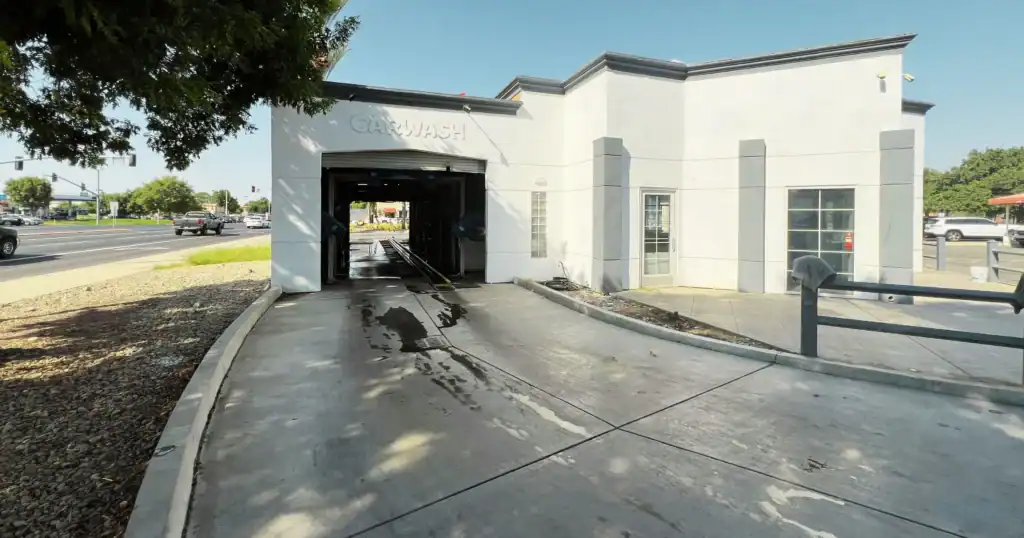
Special use property covers assets built for one purpose: car washes, self-storage, gas stations, and similar. They trade differently from generic retail or industrial because value sits in two places at once, the operating business and the land underneath it. Understanding which one you are buying is most of the work.
Why special use trades differently
A multi-tenant retail centre is valued on its rent roll. A car wash is valued on throughput, labour cost, water recycling and the corner it sits on. If the operator leaves, a generic tenant cannot simply move in, because the building is purpose-built. That concentration is the risk, and the land is the floor under it.
This is why underwriting special use assets means underwriting two things: the credit and durability of the operator, and what the site is worth if the operator goes away.
Car washes
Express tunnel formats changed the economics of this sector. Automation cut labour, membership models smoothed revenue, and water reclamation reduced operating cost. The result is an asset that behaves more like a subscription business attached to real estate than a traditional retail property.
What matters in diligence: traffic count and the ease of ingress and egress, the corner position, membership numbers and churn, the age and maintenance history of the tunnel equipment, and any water use restrictions in the jurisdiction. A strong corner with poor equipment is a different deal from good equipment on a weak corner, and they should not price the same.
Self-storage
Self-storage holds up in downturns better than most sectors because demand is driven by life events rather than discretionary spending. People move, downsize, divorce and die in every part of the cycle. Month-to-month leases also let operators reprice quickly, which is an advantage when inflation runs.
The offsetting risk is supply. Storage is comparatively cheap and quick to build, so a submarket can go from undersupplied to oversupplied in a couple of years. Check what is permitted and under construction within a three mile radius before you underwrite stabilised occupancy.
Gas stations and fuel sites
This is the sector where the land case and the operating case diverge most. Fuel volume faces a long-term transition as the vehicle fleet changes, and California is further along that curve than most states. At the same time, the sites themselves are usually hard corners with strong visibility, which is exactly what other uses want.
Two diligence points dominate: environmental condition, including tank age, testing history and any recorded releases, and whether the site works for an alternative use if fuel volume declines. Convenience and quick service food attached to the site often carry more of the income than the fuel itself.
Featured listing: Sassy Carwash, Hanford CA
We are representing an express car wash in Hanford, California. Note that Hanford is in the Central Valley rather than Southern California, so it should be underwritten against Central Valley comparables.
Pricing, income detail, equipment schedule and lease structure are available to qualified investors under a confidentiality agreement. Request the package.
What the published data actually says
Reliable public data for car wash and gas station cap rates in specific Southern California submarkets does not exist in a free, citable form. The reports that carry it, from Marcus & Millichap and The Boulder Group, are subscription or registration gated. Any broker quoting you a precise cap rate range for these sectors without naming the source and the date should be asked to produce both.
What is publicly available and worth knowing, from Marcus & Millichap’s single-tenant net lease retail research released May 2026: transaction count rose 23% year over year in 2025 with dollar volume up 20%, private investors accounted for roughly 75% of buyer dollar volume, vacancy sat below long-term averages, and construction remained near historic lows. Special use assets sit inside that net lease universe, so the direction is relevant even though the sector detail is not broken out publicly.
For self-storage specifically, Marcus & Millichap publishes an annual U.S. Self-Storage National Investment Outlook, which is the appropriate source for current cap rate and construction data.
How to approach these assets
- Underwrite the operator and the land separately. Ask what the site is worth vacant. If that number does not support your downside, the deal depends entirely on the operator continuing.
- Get the environmental work done early on fuel sites. It is the item most likely to kill a deal late.
- Check the supply pipeline for storage. Permitted and under construction, not just existing competition.
- Read the equipment schedule on car washes. Deferred maintenance on a tunnel is a capital item, not an operating one.
- Confirm the financing before you go hard. Special use lending is a narrower market than generic commercial, and terms vary more between lenders.
Frequently asked questions
Are special use properties riskier than standard commercial?
Different, not automatically riskier. The tenant concentration is higher, but the land is often more valuable per square foot because these assets sit on hard corners. The risk is concentrated rather than elevated.
What happens if the operator fails?
That is the question to underwrite before you buy. For a car wash or fuel site the building has limited alternative use, so your recovery is largely the land. For storage the building is more adaptable but still purpose-built.
How is financing different?
Fewer lenders participate, terms vary more between them, and most will want to see operator experience alongside the property. SBA programmes are used frequently for owner-operated deals. Get indicative terms early rather than assuming standard commercial pricing.
Do EV trends make gas stations a bad investment?
Not in itself, but it changes what you are buying. Underwrite the site on its real estate merits and the convenience income, and treat long-term fuel volume as the uncertain component rather than the base case.
Work with us
We broker special use assets across Southern California and the Central Valley. If you own one and want a straight read on what it would trade for, or you are looking to acquire, get in touch or see what we currently have on the market.
Nothing in this article is investment advice or a valuation opinion for any specific property. Sector figures cited are from the sources linked above; where no public source exists, no figure is given.