
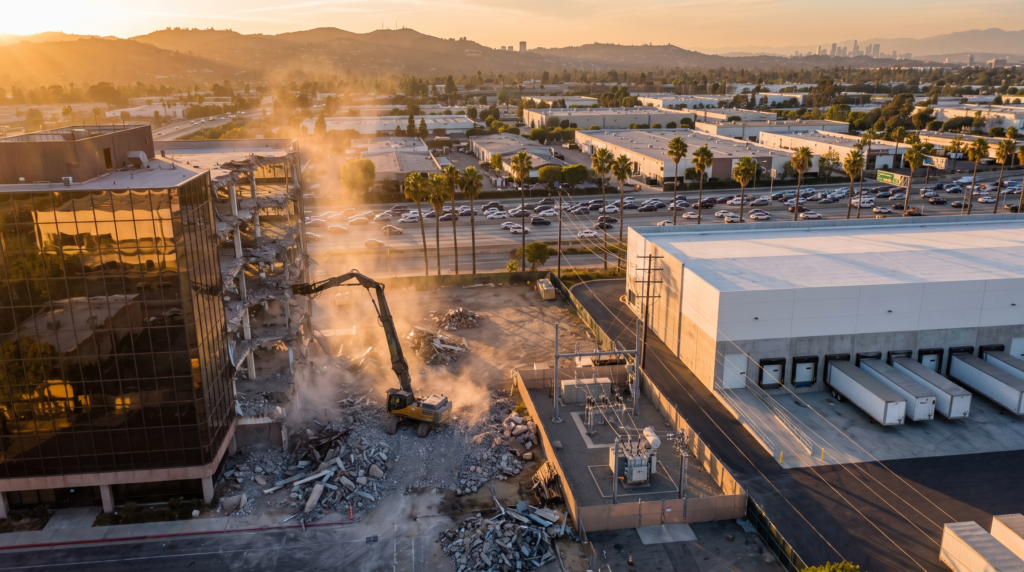
Southern California industrial redevelopment has a tell, and it is not the vacancy rate. Read the amperage instead. Two office sites in the region are being demolished for industrial buildings, and their electrical specifications differ by a factor of two. That single number tells you more about where each project’s rent is coming from than any market report will.
Key takeaways
- Southern California industrial vacancy was 7.3% in Q2 2026 against Los Angeles direct office vacancy of 16.4%, but the spread is permission to act, not the reason the trade works.
- Industrial space under construction across the region fell 32.1% year over year to 15.5 million sq. ft., with quarterly deliveries down 73.9%. The thinning pipeline is what gives 2027 deliveries pricing power.
- Electrical capacity now separates two distinct industrial products: a 4,000-amp port-adjacent logistics building and an 8,000-amp advanced manufacturing shell are not variations on a theme.
- California AB 98 took effect January 1, 2026. Facilities under 250,000 sq. ft. in industrial zones fall outside its setback mandate, which quietly favors smaller infill redevelopment over big-box.
- Most vacant office will never qualify. The filter is acreage, zoning, freeway access, neighboring uses, power and demolition economics, and most buildings fail at least one test.
The standard framing is true and not very useful
Office-to-industrial conversion has become a familiar headline, and familiar headlines tend to flatten the distinctions that matter. The usual framing is that obsolete office is being cleared for warehouses, driven by a vacancy spread everyone can recite. That framing is accurate. It is also close to useless in practice, because it does not tell you which sites qualify, what the replacement building is actually for, or how to tell one bet from another.
A more precise read is available, and it is sitting in the project specifications. Two Southern California redevelopments announced within months of each other are both office demolitions producing industrial buildings. Both are designed to 36-foot clear height. On paper they belong in the same paragraph. Their electrical service differs by 4,000 amps, and that difference is the whole story.
Two Southern California demolitions, two different industrial products
In the South Bay, Dermody acquired 18455 Figueroa St. in Los Angeles, the former Faraday Future headquarters, from Rexford Industrial, in a deal brokered by CBRE National Partners. The 8.95-acre site is slated to become LogistiCenter at 110, a 180,705-square-foot cross-dock facility with 36-foot clear height, 21 dock positions and a 4,000-amp electrical design, positioned off the 110 freeway near the Port of Los Angeles.
That is a throughput building. Every specification on the list serves the movement of containers: cross-dock configuration, dock count, clear height for racking, and a location chosen for drive time to the port. The 4,000-amp service is appropriate to a modern warehouse and unremarkable. The scarce input being captured is not power. It is dirt within reach of the harbor.
Strategic infill opportunities of this scale are exceptionally rare.
Matthew Mexia, Southern California Region Partner, Dermody
Roughly forty miles southeast, New American Funding has begun clearing an 84,000-square-foot vacant office building at 14511 Myford Road in Tustin to build a 103,566-square-foot Class A industrial facility, delivering in the second quarter of 2027. It carries the same 36-foot clear height and a modest twelve dock-high doors plus two grade-level. It also carries 8,000 amps of power available on day one, 10,800 square feet of office, a secured yard, and divisibility from 40,000 square feet up.
The stated target tenants are advanced automotive, aerospace and defense, energy, artificial intelligence, material science and biotech. That list is not a logistics list. Twelve dock doors across 103,566 square feet is a low ratio for distribution; it is a perfectly sensible ratio for a manufacturer who receives components and ships finished goods. The building is not designed to move volume. It is designed to run equipment.
Eight thousand amps on day one isn’t an amenity, it’s a prerequisite.
Louis Tomaselli, Executive Managing Director, JLL
Tomaselli’s line is quotable because it is a warning disguised as a boast. Power is now a gating item on a schedule the developer does not control. Utility interconnection and substation capacity in California are measured in years, not permitting cycles, and a site that cannot get service cannot be underwritten to an advanced-manufacturing rent no matter how good the parcel is. Delivering 8,000 amps on day one is a claim about having already solved the part of the project that cannot be solved with capital alone.
How wide is the office-to-industrial vacancy spread in Southern California?
Kidder Mathews put Los Angeles direct office vacancy at 16.4% in the second quarter of 2026, rising from 16.0% the prior quarter, with total vacancy including sublease at 17.8% and negative net absorption of roughly 1.5 million square feet. Orange County looks materially healthier at 10.9% direct, improved from 12.0% a year earlier. Nationally, Cushman & Wakefield measured office vacancy at 20.1% in the same quarter, essentially flat for eight consecutive quarters.
Set that against industrial. NAI Capital reported Southern California industrial vacancy at 7.3% regionally in the second quarter, with Los Angeles County and Orange County both at 6.5% and the Inland Empire at 8.7%. The more telling figure is on the supply side: 15.5 million square feet under construction across the region, down 32.1% year over year, with quarterly deliveries of 1.3 million square feet, down 73.9%.
That supply contraction is what makes the trade work, and it is worth separating from the demand narrative. Industrial fundamentals in Southern California have not been uniformly strong. Asking rents are down 4.7% year over year and sale prices have fallen 21.7% to $232 per square foot. This is not a market where everything is rising. It is a market where the development pipeline has thinned dramatically while demand for a specific kind of building persists. A vacancy spread gives you permission to consider a conversion. A collapsing pipeline is what gives the finished building pricing power in 2027. For a fuller breakdown of how the two industrial submarkets compare on rent and availability, see our Inland Empire vs. Orange County industrial rent comparison.
U.S. office inventory is now shrinking
CBRE research on conversions and demolitions projected that across 58 U.S. markets in 2025, 23.3 million square feet of office space would be converted or demolished (12.8 million square feet of conversions and 10.5 million of demolitions) against 12.7 million square feet of new office supply. Removal running at nearly twice delivery is a different regime from the one most office models assume.
Cushman & Wakefield data confirms it from the other direction: total U.S. office inventory has declined by roughly 33 million square feet, or 0.6%, over five quarters, with at least twenty markets shedding 1% or more of inventory annually. New completions fell 24% year over year to the lowest four-quarter total since 2012.
For anyone underwriting office, this reframes the recovery question. Absorption is not the only variable closing the gap between supply and demand. Subtraction is doing a meaningful share of the work, and every subtraction is somebody’s redevelopment thesis being executed.
Which office buildings qualify for industrial redevelopment?
The temptation, reading demolition statistics, is to treat office-to-industrial as a general escape hatch for distressed assets. It is not. The candidate set is defined by a filter that most vacant office fails, and the filter is unforgiving.
Start with geometry. Industrial needs acreage for truck movement, trailer staging and a yard, which immediately excludes the multi-story, structured-parking assets that make up most urban office. Industry guidance puts the workable range at roughly 8 to 35 acres, with Prologis citing 8 acres as a practical floor. Dermody’s 8.95-acre South Bay site sits just above that line, which is a useful reminder that even qualifying sites are often marginal on size.
Building class matters as much as acreage. Class B and Class C product dominates the candidate pool because the gap between Class A office rents and logistics rents is too wide for demolition to pencil. Vacant buildings and single-tenant buildings with expiring leases are the cleanest targets; multi-tenant properties carry buyout costs that usually kill the math. Proximity guidance runs to roughly four to five miles from a major highway, and completed conversions have clustered between one and 4.2 miles.
Then there is the arithmetic that decides whether to demolish rather than renovate. Tustin is instructive: 84,000 square feet of standing office is being replaced by 103,566 square feet of industrial. The replacement building is roughly 23% larger than the one coming down, and it will command industrial rents on a modern spec rather than office rents on a vacant 1980s box. Demolition costs money and takes time. It only clears when the new building is both bigger and worth more per foot, and on a lot of otherwise attractive sites, one of those two conditions fails.
Power belongs on this list now too, and it is the newest constraint. A site can pass every geometric and zoning test and still be unsuitable for the advanced-manufacturing product simply because the utility cannot deliver service on a timeline the capital stack can carry. Sponsors chasing that tenant base are, increasingly, underwriting an interconnection queue as much as a piece of real estate.
How California AB 98 reshapes the redevelopment math
One regulatory change deserves more attention than it is getting from investors evaluating Southern California industrial redevelopment. AB 98 took effect on January 1, 2026, establishing statewide standards for logistics-use warehouses and preempting a patchwork of local rules. It applies to new facilities and to expansions that increase square footage by more than 20%.
The operative provisions are setbacks and tiering. Loading bays must sit at least 500 feet from sensitive receptors in non-industrial zones and at least 300 feet in industrial zones. Stricter Tier 1 standards attach to facilities above 250,000 square feet. In the designated warehouse concentration regions, which include Riverside and San Bernardino counties along with specified cities, truck bays must be oriented away from sensitive receptors where feasible and truck entrances must be separated.
Now look back at the two projects. LogistiCenter at 110 is 180,705 square feet. The Tustin building is 103,566. Both sit well below the 250,000-square-foot Tier 1 threshold, and facilities under that size in industrial zones fall outside the setback mandate entirely. That is not a coincidence so much as a convergence: the same infill parcels that are too small for big-box distribution are also the ones least exposed to AB 98’s most restrictive provisions.
The practical implication is that AB 98 pushes the risk-adjusted advantage toward exactly the kind of mid-size infill redevelopment these office sites produce, and away from the large greenfield distribution boxes that dominated the last cycle in the Inland Empire. Sponsors who read the bill only as a constraint are missing half of it.
Office-to-industrial redevelopment is not a California phenomenon
Southern California is a visible example, not a special case. Foundry Commercial has built an entire platform on this trade: by its own account the firm has removed 25 office buildings totaling 2.6 million square feet and is delivering 13 industrial buildings totaling roughly 4 million square feet, representing approximately $800 million of investment.
Its Jacksonville project follows the same logic in a very different market. Foundry acquired the 457,000-square-foot former AT&T American Transtech campus at 8000 Baymeadows Way for $18 million and is replacing it with two Class A industrial buildings of 199,086 and 204,850 square feet, with delivery expected in the third quarter of 2027. Note the direction of the trade: 457,000 square feet of office becomes roughly 400,000 square feet of industrial. Unlike Tustin, this one loses square footage and still pencils, because the land basis was set by a distressed office sale and the exit is priced on infill industrial.
Opportunities like this are increasingly rare. It’s exactly the type of infill industrial product the market continues to demand.
Mark Scott, SIOR, Partner, Foundry Commercial
Two sponsors, two coasts, two different square-footage outcomes, and the same underlying observation from each: sites like this are running out. Prologis has projected that between 40 million and 80 million square feet of U.S. office space will convert to logistics use over the next decade, which sounds like a large number until you divide it across the handful of land-constrained markets where the math actually works.
Three takeaways for underwriting Southern California industrial redevelopment
First, run the industrial residual on suburban office as a standard line, not a stress case. Where a site clears the filter, that residual may set the floor on value, and in port-adjacent submarkets it can set the ceiling on what a competing office bid can rationally pay. If you are not running the number, you are bidding against people who are.
Second, decide which industrial product a site is actually for before you model rent. Port-proximate throughput and power-hungry advanced manufacturing are different tenant bases, different rent structures, different construction costs and different risks. A 4,000-amp cross-dock and an 8,000-amp manufacturing shell are not variations on a theme. Underwriting one and delivering the other is a real way to lose money on a correct thesis.
Third, remember that the trade consumes its own premise. Scarcity of developable infill land is the reason these projects work, and every completed conversion removes one more qualifying site from a finite pool. Both sponsors quoted above used almost the same word for it: rare. They are describing the opportunity and its expiry in the same breath.
The office repricing has been narrated for four years as a story about buildings and hybrid work. On the sites that clear this filter, it was never about the building. It is about the parcel, the zoning, the freeway ramp and the transformer, and the specification sheet will tell you which of those a sponsor is really buying.
Frequently asked questions about Southern California industrial redevelopment
What is office-to-industrial conversion?
Office-to-industrial conversion is the redevelopment of an obsolete or vacant office property into warehouse, logistics or manufacturing space. In most cases the existing office building is demolished rather than renovated, because office floor plates cannot deliver the clear height, dock doors and truck circulation that industrial tenants require. The value sits in the land, its zoning and its infrastructure, not in the standing structure.
Why are Southern California office buildings being demolished for warehouses?
Two conditions have to coincide, and in Southern California they do. Office demand has been permanently rebased by hybrid work, leaving Los Angeles direct office vacancy at 16.4% in the second quarter of 2026 according to Kidder Mathews. Industrial vacancy across the region was 7.3% in the same quarter according to NAI Capital, while space under construction fell 32.1% year over year. Developable infill land near the ports is effectively unavailable, so redeveloping existing sites has become one of the few remaining routes to new supply.
What size site do you need for an office-to-industrial redevelopment?
Industry guidance points to roughly 8 to 35 acres. Prologis cites 8 acres as a practical minimum and Newmark describes the wider range depending on building configuration. Dermody’s LogistiCenter at 110 site in Los Angeles is 8.95 acres, near the bottom of that band. Sites much below 8 acres rarely support the truck court, trailer staging and secured yard that industrial users need.
Which office buildings make the best industrial redevelopment candidates?
Class B and Class C properties, ideally vacant or occupied by a single tenant with a near-term lease expiration. Class A office is generally excluded because the gap between Class A office rents and logistics rents is too wide to justify demolition. Multi-tenant buildings are difficult because of tenant buyout costs. Research also points to sites within roughly four to five miles of a major highway, with completed conversions clustering between one and 4.2 miles.
How does California AB 98 affect warehouse redevelopment?
AB 98 took effect on January 1, 2026 and sets statewide standards for logistics-use warehouses, preempting many local rules. It requires 500-foot setbacks from loading bays in non-industrial zones and 300 feet in industrial zones, with stricter Tier 1 standards applying to facilities above 250,000 square feet. Facilities under 250,000 square feet located in industrial zones are not subject to the setback mandate, which is a meaningful advantage for smaller infill redevelopments.
What is the difference between a logistics building and an advanced manufacturing building?
A logistics building is designed for throughput: high dock-door ratios, cross-dock configuration, trailer parking and proximity to ports or freight corridors. An advanced manufacturing building is designed to run equipment: heavy electrical service, fewer dock doors, more office and support space, and a secured yard. Dermody’s port-adjacent LogistiCenter at 110 carries a 4,000-amp design with 21 dock positions, while New American Funding’s Tustin building carries 8,000 amps with 12 dock-high doors across a comparable footprint.
Why does electrical capacity matter so much in industrial development now?
Advanced manufacturing tenants in aerospace, defense, biotech, energy, artificial intelligence and next-generation vehicles are power-constrained before they are space-constrained. Utility interconnection and substation capacity in California are measured in years rather than permitting cycles, and cannot be accelerated with capital alone. A site that cannot obtain electrical service on schedule cannot be underwritten to advanced-manufacturing rents regardless of its location, acreage or zoning.
What are Los Angeles and Orange County office vacancy rates in 2026?
Kidder Mathews reported Los Angeles direct office vacancy at 16.4% in the second quarter of 2026, up from 16.0% the prior quarter, with total vacancy including sublease at 17.8% and negative net absorption of roughly 1.5 million square feet. Orange County direct office vacancy was 10.9%, improved from 12.0% a year earlier. Nationally, Cushman & Wakefield measured office vacancy at 20.1% in the same quarter.
What is the Southern California industrial vacancy rate in 2026?
NAI Capital reported Southern California industrial vacancy at 7.3% regionally in the second quarter of 2026. Los Angeles County and Orange County were both at 6.5%, the Inland Empire at 8.7% and Ventura County at 2.9%. Regional availability, a broader measure that includes space being marketed but not yet vacant, was 9.6%. Space under construction fell 32.1% year over year to 15.5 million square feet.
How long does an office-to-industrial redevelopment take?
Announced projects suggest roughly two to three years from acquisition to delivery. New American Funding began demolition in Tustin in 2026 for a second-quarter 2027 completion. Foundry Commercial is targeting third-quarter 2027 delivery on its Jacksonville redevelopment. Entitlement complexity and utility interconnection are the two variables most likely to extend that timeline, and both should be diligenced before the land basis is set.
Is office-to-industrial conversion still worth pursuing in 2026?
It depends entirely on whether a specific site clears the filter: acreage, zoning, freeway access, compatible neighboring land uses, available electrical capacity and an economic case for demolition over renovation. Most vacant office fails at least one of those tests. For the sites that pass, the binding constraint is time rather than opportunity, because every completed redevelopment removes another qualifying parcel from a finite regional pool.
Sources
All figures in this analysis come from company press releases and freely published broker research.
- Dermody, LogistiCenter® at 110 acquisition announcement
- New American Funding / JLL, Tustin redevelopment announcement
- Kidder Mathews, Inland Empire Industrial Market Report, Q2 2026
- Kidder Mathews, Los Angeles Office Market Report, Q2 2026
- Kidder Mathews, Orange County Office Market Report, Q2 2026
- NAI Capital, SoCal Industrial Market Report, Q2 2026
- CBRE, Conversions & Demolitions Reducing U.S. Office Supply
- Cushman & Wakefield, U.S. Office MarketBeat, Q2 2026
- Foundry Commercial, 8000 Baymeadows announcement and Jax Daily Record coverage
- Meyers Nave, AB 98 Enacts Statewide Standards for Logistics Use Warehouses
- NAIOP, Office-to-Industrial Conversions: A Niche Market Worth Exploring
Work with Southern California industrial redevelopment specialists
KEYZ Commercial advises owners, investors and tenants across the Inland Empire, Orange County and Los Angeles industrial markets. If you are evaluating a site for redevelopment, weighing an industrial residual against a competing office bid, or trying to work out which industrial product a parcel actually supports, we can help you run the numbers before you commit.
Contact KEYZ Commercial: hello@keyz.com | 888.539.9101 (KEYZ 101) | read our Inland Empire vs. Orange County rent comparison for the underlying market data.