
Cumulative vs. Non-Cumulative Caps on Operating Expenses in Commercial Leases

In many commercial real estate leases—including the AIR standard form—tenants are often responsible for a portion of the operating expenses (like maintenance, landscaping, repairs, etc.) through Additional Rent or Common Area Maintenance (CAM) charges. To protect tenants from significant year-over-year increases, leases may include a cap on how much operating expenses can increase annually. These caps are usually defined as either:

Cumulative
Non-Cumulative

Understanding the difference between the two is critical for landlords, tenants, attorneys, and property managers to budget, bill, and negotiate leases fairly.

The Key Difference: Compounding Effect
Feature
Cumulative Cap
Non-Cumulative Cap

Cap Effect
Increases compound over time like a staircase.
Cap resets every year—only applies to that year.

Tenant Protection
More generous to the landlord over time.
More protective for the tenant year by year.

Landlord Recovery
Allows landlord to catch up on prior year shortfalls.
Landlord cannot recover unbilled increases from past.

Example Year 3 Cap Based on Year 1
105% x 105% x 105% = ~115.8% of Year 1 (compounded)
Still only 105% of Year 2 (not compounded)

A Simple Example
Let’s assume the tenant pays $100,000 in reimbursable CAM expenses in Year 1.

Scenario A: Cumulative 5% Cap
Each year, the cap compounds:

Year 2 Max: $100,000 × 1.05 = $105,000
Year 3 Max: $105,000 × 1.05 = $110,250
Year 4 Max: $110,250 × 1.05 = $115,762.50

So by Year 4, the landlord could charge up to $115,762.50.

Scenario B: Non-Cumulative 5% Cap
Each year, the cap resets based on the prior year only:

Year 2 Max: $100,000 × 1.05 = $105,000
Year 3 Max: $105,000 × 1.05 = $110,250
Year 4 Max: $110,250 × 1.05 = $115,762.50

So… they look the same?
Nope! Here’s the catch—what if the landlord didn’t increase the expenses to the max in a prior year?

Catch-Up Limitations
Here’s where it gets interesting.

Imagine in Year 2, actual charges were only $102,000 (under the cap):

Under a Cumulative Cap:
In Year 3, the landlord can still bill up to the compounded cap:
Year 3 Max: $110,250 (even if Year 2 was underused)

Under a Non-Cumulative Cap:
Year 3 is now limited to just 105% of $102,000, not Year 1:
Year 3 Max: $102,000 × 1.05 = $107,100

So the landlord loses the unused room to increase expenses. It does not carry forward.

Why It Matters for Property Managers and Accountants
Cumulative Caps require tracking prior years’ billed amounts and allowable increases to ensure landlords don’t exceed the total compounded cap.

Non-Cumulative Caps are easier to administer but limit recoverable costs if the landlord keeps increases low early on.

Audit & Compliance: You need clear records to demonstrate that cumulative increases are calculated correctly and to avoid disputes.

Budgeting: Knowing which cap type applies helps your team budget CAM recoveries more accurately year over year.

Final Tip: Look for “Cumulative Basis” in the Lease
If you see language similar to this:

“…shall not exceed one hundred five percent (105%), on a cumulative basis, of the portion of Tenant’s Additional Rent attributable to Common Area Expenses payable by Tenant for the previous year.”

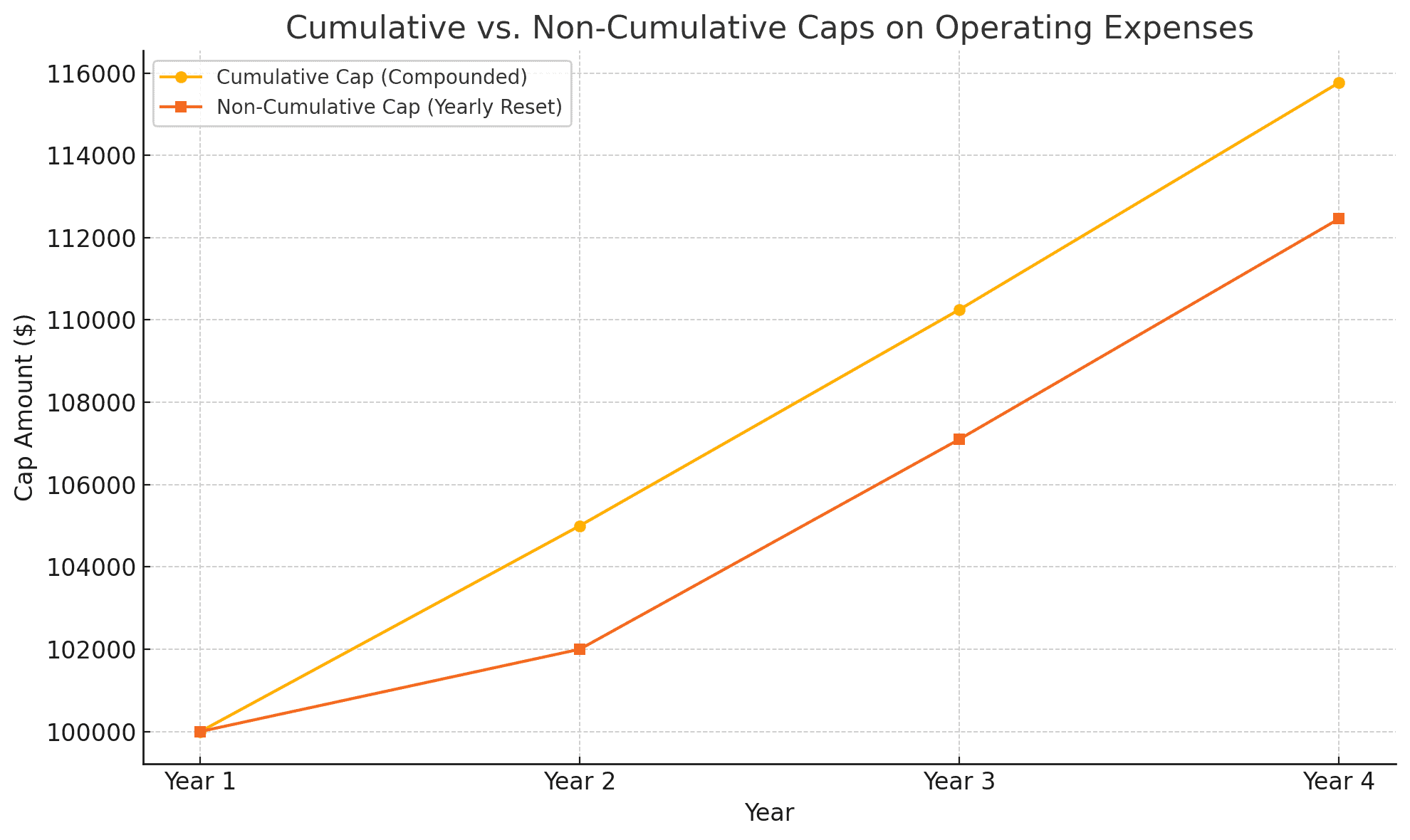
4-year comparison of cumulative vs. non-cumulative caps on operating expenses, highlighting compounding vs. annual reset effects


Year Cumulative Cap (Compounding) Non-Cumulative Cap (Reset Each Year)
Year 1 $100,000 $100,000
Year 2 $105,000 $105,000
Year 3 $110,250 $102,000 × 1.05 = $107,100
Year 4 $115,762 $107,100 × 1.05 = $112,455

Reviewing expense caps in a commercial lease? Browse our current commercial real estate listings or contact the KEYZ Commercial team for guidance.

Cumulative vs. Non-Cumulative Caps: FAQ

What does a non-cumulative cap mean?

With a non-cumulative cap, the allowable increase in a tenant’s controllable operating expenses is figured for each year on its own, and any unused portion does not carry forward. If the landlord does not use the full permitted increase in a given year, that room is lost. It is the most tenant-favorable structure.

What does a cumulative cap mean?

A cumulative cap lets the landlord carry forward unused increases from earlier years. If expenses rose less than the cap in prior years, the landlord can bank that unused room and apply it in a later year when costs spike, which favors the landlord.

What is the difference between a cumulative cap and a compounding cap?

A cumulative cap carries forward unused increases. A compounding cap calculates each year’s ceiling on top of the prior year’s capped amount, so the ceiling grows faster over time. A cumulative compounding cap combines both and is the most landlord-favorable of the common structures.

What is a CAM cap?

A CAM cap limits how much a tenant’s share of controllable common area maintenance expenses can rise year over year. Taxes, insurance, and utilities are often carved out as uncontrollable costs.

Which cap structure is best for a tenant?

A non-cumulative, non-compounding cap is the most protective for tenants, because it limits each year’s increase on its own with no carry-forward or compounding. If you are negotiating a lease, our team can help you push for the most favorable cap language. Contact KEYZ Commercial.

Scroll to Top