
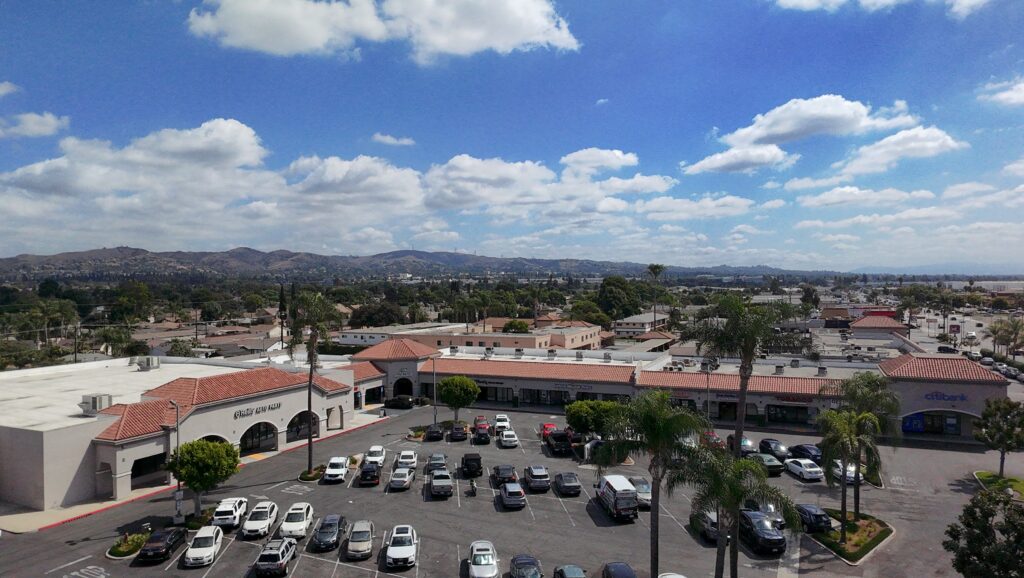
View Santa Fe Springs Marketplace property details
Location remains the single most important factor in retail success. E-commerce keeps reshaping how people shop, yet well-positioned brick-and-mortar centers in high-traffic areas continue to produce strong results for tenants and property owners. In Southeast Los Angeles County, few locations combine demographics, access and market position the way Santa Fe Springs Marketplace does.
At KEYZ Commercial, we have analyzed retail performance across the Inland Empire and Los Angeles County for over two decades. Successful retail locations share a common profile: strong traffic counts, easy ingress and egress, favorable demographics within a three-mile radius, and proximity to anchors that drive repeat visits.
Santa Fe Springs Marketplace fits that profile. KEYZ Commercial is the exclusive brokerage for Santa Fe Springs Marketplace, and this analysis covers why the center keeps attracting tenants and investor interest, what it costs to occupy or own space there, and the risks worth weighing before you commit.
Santa Fe Springs’ Strategic Market Position
Santa Fe Springs sits where several of Southern California’s largest population centers meet, with direct access to the freeway network that connects it to both Los Angeles County and Orange County.
Demographics That Drive Retail Performance
The households around Santa Fe Springs Marketplace give retailers a stable, family-oriented customer base with solid spending power. According to the U.S. Census Bureau, the City of Santa Fe Springs has a median household income of $88,238 (2020-2024, in 2024 dollars), an average of 3.24 persons per household and an owner-occupied housing rate of 60.6%. The city itself is small, with about 18,800 residents, but the three-mile trade area draws on the much larger surrounding communities of Whittier, Norwalk, Downey and Pico Rivera.
| Metric (City of Santa Fe Springs) | Value | Why It Matters for Retail |
|---|---|---|
| Median household income (2020-2024, 2024 dollars) | $88,238 | Supports value and mid-market brands across categories |
| Persons per household (2020-2024) | 3.24 | Larger households drive grocery, household goods and family dining |
| Owner-occupied housing rate (2020-2024) | 60.6% | Long-tenured residents mean loyal, repeat customers |
| Population estimate (July 1, 2025) | 18,793 | A small city base inside a much larger, dense trade area |
Source: U.S. Census Bureau QuickFacts, Santa Fe Springs city, California.
That income level supports a wide range of retail, from everyday convenience and services to dining, personal care and specialty retail. The area’s composition also provides stability. Unlike markets dependent on seasonal tourism or a single industry, Santa Fe Springs serves an established residential population with consistent spending throughout the year.
The city’s industrial base adds a second customer stream. Thousands of warehouse, logistics and manufacturing employees work nearby, creating lunch-hour and after-work traffic that purely residential areas cannot deliver. Restaurants, service providers and quick-stop retail benefit most from that daytime population.
Transportation Access and Visibility
The center sits on the corner of Norwalk Boulevard and Washington Boulevard, about a mile and a half east of the I-605 interchange at Washington Boulevard. Caltrans’ 2023 traffic counts put the I-605 at roughly 215,000 to 225,000 vehicles per day at that interchange, and the I-5 and I-105 are also a short drive away. That freeway network gives the center regional reach for both customers and employees.
Washington Boulevard and Norwalk Boulevard are both major arterials, so the center’s corner position gives tenants frontage and visibility on two busy streets. That exposure builds awareness and drives impulse visits. For retail space to succeed, people must know it exists and be able to reach it easily, and Santa Fe Springs delivers both.
The city is also a natural stopping point for commuters traveling between employment centers in Downtown Los Angeles, Vernon, Commerce and Orange County. That commuter traffic adds customers beyond the immediate residential base and spreads visits across multiple dayparts.
Competitive Landscape and Market Gaps
Santa Fe Springs offers a mature but not oversaturated retail environment. Several established shopping centers and big-box retailers act as traffic generators while leaving room for complementary tenants.
The marketplace sits in a secondary retail node rather than a primary regional destination. That means lower occupancy costs than premium locations like Lakewood Center or Los Cerritos Center, while still capturing substantial customer traffic. Retailers can serve the same customer base at lower fixed costs and better margins.
Demand in the area is growing for fast-casual dining, health and wellness services, specialty food and experiential retail. These categories give forward-thinking retailers a chance to establish strong positions before competition intensifies.
The Neighborhood Retail Center Advantage
Santa Fe Springs Marketplace operates as a neighborhood retail center, a format with distinct advantages over enclosed regional malls and large power centers.
Convenience-Focused Shopping Patterns
Today’s consumers prioritize convenience. Neighborhood centers serve nearby residents for frequent-purchase categories: groceries, pharmacy, personal services, quick-service dining and everyday retail. That creates consistent traffic that does not depend on destination shopping trips.
Grocery-anchored centers earn their traffic through repeat visits. ICSC research found that half of American adults visited an open-air shopping center in the previous seven days, averaging two visits in that period. Frequency, not trip length, is what supports the tenants around a grocer.
At Santa Fe Springs Marketplace that anchor is Food 4 Less, alongside the center’s other anchor tenants and O’Reilly Auto Parts. A full-service grocer is the most valuable traffic driver a center of this type can have, because grocery trips recur weekly rather than seasonally. Every inline tenant benefits from that rhythm, which is why quick-service food, personal services and convenience retail perform well in the adjacent suites.
The convenience factor has strengthened since 2020. Consumers increasingly favor retail they can reach within 10-15 minutes of home and prefer to complete several errands in one stop. Multi-tenant centers that combine groceries, services and dining capture that shift directly.
Tenant Mix Synergies
Successful centers create synergies where tenant categories complement each other. A grocery anchor draws frequent visits that expose customers to adjacent tenants. Salons and dry cleaners build regular relationships that bring customers back, and those customers also use the restaurants and specialty retailers nearby.
The categories that drive this kind of center are:
- Grocery and food services: anchors that generate multiple weekly visits
- Health and wellness: fitness, medical offices and pharmacies serving ongoing needs
- Personal services: salons, dry cleaners and repair businesses that create repeat customers
- Restaurants and quick-service dining: capturing lunch crowds and dinner traffic
- Specialty retail: niche stores that differentiate the center from online alternatives
This diversity also reduces risk for owners. When one category faces headwinds, such as apparel competing with e-commerce, strength in grocery or healthcare keeps the center stable.
Operational Efficiency for Tenants
Neighborhood centers typically require smaller footprints than destination retail, which lowers build-out and occupancy costs. A quick-service restaurant might operate efficiently in 1,800-2,500 square feet in a neighborhood center, whereas a freestanding location might need 3,000-4,000 square feet plus land and parking.
That efficiency improves unit economics. Lower rent and operating costs let tenants reach profitability at lower sales volumes, and smaller build-outs lower the barrier to entry for emerging concepts and multi-unit operators. For landlords, tenant demand in these convenience categories tends to hold up better in uncertain economies because the spending is less discretionary.
Key Competitive Advantages of Santa Fe Springs Marketplace
Several specific attributes set Santa Fe Springs Marketplace apart from competing retail properties in Southeast Los Angeles County.
Parking and Site Configuration
Convenient parking often decides which center a customer chooses. Santa Fe Springs Marketplace provides parking ratios above minimum requirements, so customers can park close to their destination even at peak hours. Multiple access points and clear sightlines to storefronts help customers find their destination quickly, a small detail that has a real effect on return visits.
Property Management and Maintenance Standards
Well-maintained properties command stronger rents and attract better tenants. Deferred maintenance signals decline to customers, which reduces traffic and hurts tenant performance. Professional management maintains the physical condition, enforces operating standards and creates a cohesive center identity, which reassures both prospective tenants and investors.
Lease Flexibility and Terms
Typical retail lease terms in the center range from three to ten years depending on tenant type and space requirements. Restaurants and service providers often prefer longer terms that justify build-out investments, while smaller specialty retailers may seek shorter commitments with renewal options. Accommodating both broadens the potential tenant pool.
Co-Tenancy Protections and Center Marketing
Strong neighborhood centers provide co-tenancy protections so inline tenants are covered if an anchor closes or overall occupancy drops. Center-wide marketing also helps smaller tenants who lack the budget for their own campaigns, by promoting the property as a whole.
Modernization Without Losing Its Identity
The best retail centers evolve without losing their core character. Santa Fe Springs Marketplace has attracted contemporary tenants while keeping the community feel that draws loyal customers. Centers that chase trends too aggressively risk alienating existing shoppers, while centers that resist change become obsolete. Finding the middle ground takes active management.
Market Trends Favoring Well-Positioned Retail Centers
Several broader trends currently favor centers like Santa Fe Springs Marketplace.
The Omnichannel Retail Reality
E-commerce has not eliminated physical retail. It has changed how successful retailers use it. Stores now serve as pickup points for buy-online-pickup-in-store orders, local fulfillment hubs and brand touchpoints. Retailers need physical space close to customers, and properties in dense, accessible trade areas benefit directly.
Essential Services and Necessity Retail
Grocery, healthcare and personal services held up through recent economic uncertainty and continue to perform. These necessity-based tenants generate steady traffic regardless of economic conditions, which gives centers built around them a stability that discretionary-focused centers lack.
Industrial Market Spillover
The growth of warehousing and logistics across Southeast Los Angeles County and the Inland Empire creates spillover demand for nearby retail. Workers need places to eat, shop and run errands close to work. Retail near major employment centers enjoys sustained demand that purely residential areas cannot match, and Santa Fe Springs benefits directly.
Limited New Supply
New retail development in the area remains limited by land constraints and zoning, which protects existing centers from excessive new competition. When supply stays controlled and demand holds, landlords keep pricing power and well-located tenants keep their market position.
Financial Considerations for Tenants and Investors
Understanding the financial side of a retail lease or acquisition helps both tenants and investors make decisions that fit their goals.
Rental Rate Analysis
Retail rents in Santa Fe Springs typically range from $2.00 to $3.50 per square foot per month for neighborhood center space, depending on location within the center, tenant improvements and lease structure. Inline spaces generally fall toward the lower end of this range, while endcap and pad locations with greater visibility command premium rates.
Those rates compare favorably with surrounding markets. Comparable space in Whittier or Downey often runs $0.50-$1.00 per square foot more, and premium locations in Long Beach or Cerritos can reach $4.00-$5.00 per square foot. Santa Fe Springs offers similar access and demographics at a lower cost structure.
Common Area Maintenance and Operating Expenses
Most retail leases are triple-net (NNN) or modified gross, with tenants paying a proportionate share of operating expenses. At Santa Fe Springs Marketplace, typical CAM charges range from $0.40 to $0.75 per square foot per month, covering maintenance, landscaping, parking lot upkeep, insurance, property taxes and management.
Tenants should evaluate total occupancy cost, base rent plus NNN charges, rather than base rent alone. A space at $2.50 base rent with $0.50 NNN costs the same as one at $2.25 base rent with $0.75 NNN, but the split affects how costs escalate over time.
Build-Out Allowances and Tenant Improvements
Landlords typically provide tenant improvement allowances to offset build-out costs, particularly for longer terms or larger spaces that strengthen the center. At Santa Fe Springs, these allowances generally range from $15 to $40 per square foot depending on lease term, tenant credit and strategic fit. Restaurants with extensive kitchen infrastructure often negotiate higher allowances, while service tenants with lighter build-outs may trade a lower allowance for better rent or terms.
Investment Metrics for Property Owners
Neighborhood centers like Santa Fe Springs Marketplace typically trade at capitalization rates between 5.5% and 7.0%, depending on occupancy, tenant credit, lease term and property condition. Annual net operating income growth at stabilized centers typically runs 2% to 4%, driven by contractual rent increases and renewals at market rates.
Several factors keep investor interest in this kind of asset:
- Stable cash flow. A grocery-anchored tenant mix and solid demographics support reliable rent collection and occupancy. Santa Fe Springs Marketplace is anchored by Food 4 Less, a Kroger banner, which is the kind of grocery credit that underwrites well.
- Value-add potential. Well-located centers with good bones can raise returns through tenant remixing, facade upgrades, parking improvements or common area enhancements, without ground-up development risk.
- Pricing for quality. Capital has concentrated in proven, necessity-based retail, so well-positioned centers trade at a premium to weaker assets. That supports exit liquidity for current owners.
- Financing access. Lenders differentiate sharply between retail assets. Properties with strong demographics, diverse tenants and steady performance get better terms than distressed centers, for both acquisitions and refinancing.
Current Market Dynamics in Southeast Los Angeles Retail
Supply and Demand Fundamentals
Retail availability across Los Angeles County remains relatively tight, and new construction in established Southeast LA neighborhoods is minimal. Published vacancy figures vary between sources because each defines the tracked inventory differently, and no source publishes a reliable figure for this specific submarket, so treat any submarket vacancy number you are quoted with caution. For current availability and quoted rates at Santa Fe Springs Marketplace, contact us for the marketing package.
A tight market favors landlords and supports stable rents. For tenants, it underscores the value of securing well-located space before options narrow further.
Tenant Category Performance
Not all retail categories perform equally. Fast-casual dining, health and wellness, personal care, specialty food and beverage, and discount or value retail continue to show strength. Traditional apparel still faces e-commerce headwinds, though specialty apparel and athleisure have proven more resilient. Big-box retail is bifurcated, with value concepts such as discount grocers performing well while department stores struggle.
Competition and Tenant Recruitment
Owners compete for quality tenants, particularly proven concepts with strong unit economics. National and regional chains weigh multiple proposals for every expansion decision, so properties that can demonstrate real locational and demographic advantages win those competitions.
Challenges and Risk Factors
No retail property operates without challenges. An honest analysis weighs these alongside the strengths.
Evolving Consumer Expectations
Physical retail has to keep justifying itself against online alternatives. Centers succeed when they offer convenience, experience or immediate gratification that e-commerce cannot. Spaces that feel dated lose traffic to both physical and digital competitors.
Maintenance and Capital Investment
Mature retail properties require ongoing capital investment to stay competitive. Deferred maintenance quickly erodes market position. Owners need to balance capital spending against returns, prioritizing improvements such as facades, parking lot resurfacing and lighting that protect asset value.
Tenant Credit and Economic Sensitivity
Economic uncertainty affects tenant creditworthiness, particularly for smaller local operators. Landlords must balance rents against tenant viability to limit vacancy risk. Strong fundamentals help, but no property is immune to economic cycles, so prudent owners keep reserves and monitor tenant health.
Regional Economic Pressures
Southern California faces ongoing challenges from housing affordability, regulatory costs and periodic downturns, all of which can affect consumer spending and tenant demand. Understanding that context helps investors set realistic return expectations and structure deals accordingly.
Strategic Considerations for Retailers and Owners
For Retailers Evaluating Santa Fe Springs
Trade area analysis. Most neighborhood centers draw 70-80% of customers from within a three-mile radius, so that geography is critical. Key metrics include population density, household income distribution, age and household size. GIS tools and data providers such as Esri or Placer.ai add detail that sharpens site selection.
Site-specific traffic patterns. Endcap locations with direct visibility from main roads generate more impulse traffic than interior inline suites, and proximity to the anchor affects foot traffic. Visit at different times and days to see where customers park, how they move through the center and which suites get the most exposure.
Positioning within the center. Complementary neighbors create positive synergy, while incompatible ones create friction. Understanding the landlord’s leasing strategy and planned tenant mix helps predict how the center will look in a few years.
Expansion and exit terms. Review expansion rights, renewal options and exit provisions. A right of first refusal on adjacent space gives a growing concept room to expand, defined renewal terms remove uncertainty about future costs, and reasonable exit provisions protect both sides.
For Property Owners and Investors
Focus on tenant retention. In a mature center, keeping good tenants often matters more than re-leasing space. Turnover costs money in lost rent, leasing commissions and improvement allowances, so responsive management and fair renewal terms pay off.
Monitor adjacent development. Residential projects, industrial growth and infrastructure changes can strengthen or challenge a center’s position. Track traffic patterns, new competition and demographic shifts continuously.
Use data in decisions. Traffic, demographic, tenant sales and competitive data lead to better leasing and capital decisions than intuition alone.
How KEYZ Commercial Supports Retail Real Estate Success
KEYZ Commercial brings specialized expertise in Southeast Los Angeles retail to help clients make sound real estate decisions. Our approach starts with your business model, growth objectives and risk tolerance rather than simply completing a transaction.
Whether you are a retailer looking for your next location, an owner evaluating repositioning, or an investor analyzing an acquisition, we track lease comparables, traffic patterns and demographic trends across our coverage area to give you specific, actionable guidance. Our relationships with owners and operators across the region also give our clients early visibility into opportunities before they reach the broader market.
Practical Recommendations for Retail Real Estate Decisions
- Prioritize location over deal terms. A mediocre lease in an excellent location outperforms an excellent lease in a mediocre one.
- Evaluate total occupancy cost. NNN charges, utilities, marketing funds and percentage rent all affect your real monthly cost.
- Negotiate improvement allowances that fit your build-out. Landlords often have more flexibility on allowances than on base rent.
- Secure expansion rights if growth is possible. A right of first refusal on adjacent space is valuable if your business takes off.
- Understand co-tenancy protections. Your lease should protect you if an anchor leaves or occupancy drops below a set threshold.
- Visit the site multiple times. Traffic patterns and operational issues show up in person in ways paper analysis misses.
- Work with advisors who know the market. Specialized local expertise pays for itself through better terms and fewer surprises.
Key Takeaways
- Santa Fe Springs Marketplace combines freeway access, a grocery anchor and a stable, family-oriented trade area, the core ingredients of a successful neighborhood center.
- A diverse, necessity-based tenant mix insulates the center from swings in any single retail category.
- Convenience shopping, omnichannel strategies and industrial employment growth all favor well-located community centers.
- Rents run below surrounding markets like Whittier, Downey, Long Beach and Cerritos, giving tenants access to similar demographics at lower cost.
- Quality, grocery-anchored assets continue to attract capital and favorable financing, but owners still need to plan for capital improvements and economic cycles.
- Successful leasing and investment decisions rest on location fundamentals, total occupancy cost and lease structure, not rent alone.
Frequently Asked Questions
What makes Santa Fe Springs Marketplace different from other retail centers in the area?
The combination of freeway access, a Food 4 Less grocery anchor and a trade area that mixes established households with a large daytime workforce. Its corner location on two major arterials, a short drive from the I-605 and I-5, gives it regional reach, while the surrounding residential and industrial base creates steady traffic that many competing centers cannot match.
What types of retail businesses succeed at Santa Fe Springs Marketplace?
Convenience-oriented categories perform best: fast-casual and quick-service restaurants, personal services such as salons, dry cleaning and repairs, health and wellness, specialty food, and value-oriented retailers. These businesses benefit from the repeat traffic the grocery anchor generates.
How do rental rates in Santa Fe Springs compare to surrounding markets?
Neighborhood center space in Santa Fe Springs typically runs $2.00-$3.50 per square foot per month, compared to roughly $2.50-$4.50 in Whittier, $3.00-$5.00 in Long Beach and $3.50-$5.50 in Cerritos. That gives tenants access to similar demographics and traffic at lower occupancy costs.
What lease terms are typical for retail space at Santa Fe Springs Marketplace?
Most retail leases run three to ten years depending on tenant category and space requirements. Restaurants and service providers often sign five to ten-year terms to justify build-out costs, while smaller specialty retailers may prefer three to five years with renewal options. Most leases include annual rent increases of 2-3%.
Are tenant improvement allowances available?
Yes. Allowances typically range from $15-$40 per square foot depending on lease term, space size and tenant requirements. Restaurants with extensive kitchen needs often receive higher allowances than service or retail tenants with lighter build-outs.
Is neighborhood retail still a good investment given e-commerce growth?
Well-located centers built around necessity-based tenants continue to perform. Grocery, healthcare, personal services and dining depend on physical presence, which is why centers anchored by these categories have held occupancy better than discretionary-focused retail.
What should investors consider when evaluating neighborhood retail centers?
Key factors include anchor credit quality and remaining lease term, overall occupancy and lease rollover schedule, trade area demographics and competition, property condition and deferred maintenance, and room for rent growth at renewal. Cap rates for well-positioned neighborhood centers typically range from 5.5% to 7.0%.
How can property owners maximize value in a retail center?
Maintain the property, curate a complementary tenant mix, keep good tenants through fair renewals and responsive management, and make targeted capital improvements such as facade, parking and lighting upgrades. Working with advisors who know the local market helps time those decisions well.
Where can I see availability at Santa Fe Springs Marketplace?
View the Santa Fe Springs Marketplace property details, browse all available listings, or contact KEYZ Commercial for current suite sizes and quoted rates.
Ready to Explore Retail Opportunities in Santa Fe Springs?
KEYZ Commercial specializes in retail real estate throughout Southeast Los Angeles County and the Inland Empire. Whether you are expanding a retail concept, repositioning a property or evaluating an investment, our team combines local market knowledge with transaction experience to help you move with confidence.
Schedule a consultation with KEYZ Commercial or browse available retail listings.
Sources
- U.S. Census Bureau QuickFacts, Santa Fe Springs city, California
- ICSC, Shopping Center Visitation Research
- Caltrans, 2023 Annual Average Daily Traffic (I-605 at Washington Blvd)
- City of Santa Fe Springs, Economic Development
Retail rents in Southern California are quoted per square foot per month. Rent, CAM, tenant improvement and cap rate ranges above reflect what we commonly see in this market rather than published survey data, and vary by center, suite and deal. Demographic figures are for the City of Santa Fe Springs from the U.S. Census Bureau. For current availability, suite sizes and quoted rates at Santa Fe Springs Marketplace, contact us for the marketing package.